
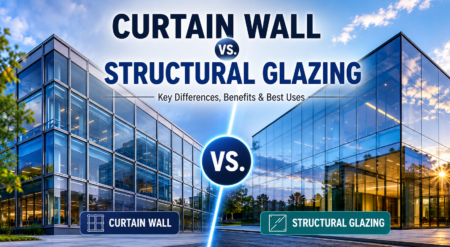
Modern commercial buildings increasingly rely on large glazed facades to maximise natural light, improve aesthetics, and create a contemporary appearance. Two of the most common facade solutions are curtain walling and structural glazing.
While both systems use glass extensively, they differ in how they are designed, installed, and maintained. Understanding these differences can help architects, developers, and commercial property owners choose the right solution for their project.
If you’re looking for a broader overview of facade systems, see our guide to Glass Curtain Walling.
Curtain Wall vs. Structural Glazing – What’s the Difference?
The main difference lies in how the glass is supported.
Curtain walling uses visible aluminium framing to hold glass panels in place.
Structural glazing bonds glass to the structure using specialist silicone, creating a seamless appearance with little or no visible framing.
Both systems are designed to create weather-resistant building envelopes, but they achieve this in different ways.
| Feature | Curtain Walling | Structural Glazing |
| Visible Frames | Yes | Minimal or none |
| Glass Appearance | Framed panels | Continuous glass surface |
| Installation Method | Mechanical fixing system | Structural silicone bonding |
| Architectural Style | Traditional modern façade | Premium seamless façade |
| Maintenance Access | Easier | More specialised |
| Replacement Process | Simpler | More complex |
| Initial Cost | Typically lower | Usually higher |
| Design Flexibility | High | Very high |
What is Curtain Walling?
Curtain walling is a non-structural external facade system attached to a building’s frame. It typically consists of:
- Aluminium mullions and transoms.
- Double or triple glazed units.
- Thermal insulation components.
- Weatherproof seals.
Because the framing remains visible, curtain walling creates a defined architectural appearance while providing excellent performance.
Common Applications
- Office buildings
- Business parks
- Educational facilities
- Healthcare buildings
- Retail developments
Read More: What is Curtain Walling?
What is Structural Glazing?
Structural glazing is a facade system where glass panels are bonded directly to the supporting structure.
This allows the building to achieve a continuous glass appearance with minimal external framework visible.
The result is a cleaner facade that emphasises glass rather than framing.
Common Applications
- Corporate headquarters
- Premium office developments
- Luxury hotels
- Airports
- High-end commercial buildings
Which System Looks Better?
The answer depends on the design objective.
Curtain Walling Provides:
- Defined architectural lines.
- Visible framing details.
- A professional commercial appearance.
- Flexibility in frame finishes and colours.
Structural Glazing Provides:
- Seamless glass elevations.
- Minimal visual interruption.
- Contemporary architectural aesthetics.
- Maximum transparency.
For projects where visual impact is a priority, structural glazing is often preferred.
For projects balancing appearance, practicality, and budget, curtain walling is commonly selected.
Which is More Cost Effective?
Cost varies depending on the building size, specification, and installation requirements.
Curtain Walling
- Lower installation costs.
- Faster installation.
- Easier maintenance.
- Simpler replacement of damaged panels.
Structural Glazing
- Premium appearance.
- Greater design flexibility.
- Higher installation costs.
- More specialist maintenance requirements.
For many commercial developments, curtain walling offers a lower overall lifecycle cost.
Which Performs Better for Energy Efficiency?
There is no clear winner. The energy performance of a façade depends largely on:
- Glass specification.
- Double or triple glazing.
- Thermal breaks.
- Solar control coatings.
- Air-tightness.
Both curtain walling and structural glazing can achieve excellent thermal performance when designed correctly.
Which System is Easier to Maintain?
Maintenance is often overlooked during the design stage but can significantly impact long-term operating costs.
Curtain Walling Benefits include:
- Easier access to components.
- Simpler glass replacement.
- Lower maintenance complexity.
- Reduced downtime during repairs.
Structural Glazing May require:
- Specialist inspections.
- Silicone joint assessments.
- More complex replacement procedures.
For buildings prioritising operational efficiency, curtain walling often provides practical advantages.
When Should You Choose Curtain Walling?
Curtain walling may be the right choice if:
- Budget is an important factor.
- Long-term maintenance costs need to be controlled.
- The project involves large commercial developments.
- Practicality is as important as appearance.
- Future replacement access is a consideration.
H2: When Should You Choose Structural Glazing?
Structural glazing may be the right choice if:
- A seamless façade is desired.
- Architectural appearance is the priority.
- The project targets a premium market.
- Maximum glass visibility is required.
- A contemporary aesthetic is essential.
Curtain Walling vs. Structural Glazing: Pros and Cons
| System | Advantages | Considerations |
| Curtain Walling | Lower cost, easier maintenance, straightforward repairs | Visible framing |
| Structural Glazing | Seamless appearance, premium aesthetics, greater transparency | Higher cost, specialist installation |
Final Thoughts
Both curtain walling and structural glazing offer excellent performance for commercial buildings, but they serve slightly different objectives.
Curtain walling is often chosen for its balance of cost, durability, maintenance accessibility, and proven performance. Structural glazing, on the other hand, is frequently specified when achieving a seamless glass façade is a key architectural requirement.
The best choice depends on your project’s budget, design goals, maintenance strategy, and long-term building requirements. Evaluating these factors early can help ensure the façade system supports both the appearance and performance of the building for years to come.
FAQs
Yes. Many commercial developments combine both systems, using curtain walling on larger elevations and structural glazing in feature areas or entrance façades.
Curtain walling remains one of the most widely used façade systems for office developments due to its balance of performance, cost efficiency, and maintenance accessibility.
Structural glazing can create a greater glass-to-frame ratio, allowing more daylight to enter a building and creating a more open appearance.
Yes. However, replacement is generally simpler with curtain walling, while structural glazing may require specialist procedures.
Yes. Structural glazing is commonly used on high-rise commercial buildings when designed and engineered to meet project-specific structural requirements.
Structural glazing is often preferred for projects seeking uninterrupted glass façades, while curtain walling provides greater flexibility in frame design, finishes, and configurations.
A well-designed façade can contribute to the perceived value and visual appeal of a commercial property, although the overall impact depends on multiple factors including location, design, and building performance.